Books always influence my thinking and perception of the world around me. That’s always a privilege. But from time to time, I encounter a book that opens a new dimension of life for me by serving as a ladder or helping hand to overcome a barrier that seemed insurmountable before. Such a ladder is Mark Oakley’s The Splash of Words. Believing in Poetry.
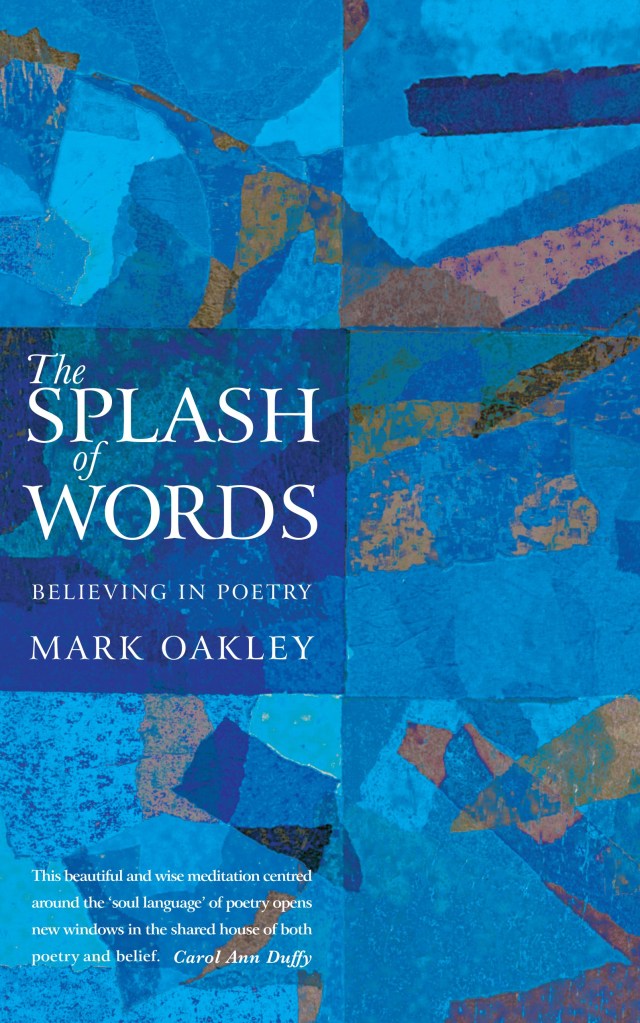
Oakley meditates on poems of both contemporary and earlier authors across 29 chapters. Each begins with a poem, followed by Oakley’s personal reflections. Most chapters include a brief analysis, but not a word-by-word breakdown. Instead, Oakley intertwines his reflections and analyses with other verses, biographical details, and related writings. Questions of faith and personal beliefs appear subtly, making them even more powerful.
Like many, I first encountered poetry in school, but that relationship ended before it began due to the curriculum’s requirements and an unhelpful teacher. Later, I developed a deep appreciation for Biblical poetry, especially the psalms, which became part of my daily prayer. Still, engaging with poetry outside that context felt daunting and impossible — until recently, when I found myself asking once again why Biblical poetry held such importance for me while all other poetry remained inaccessible.
This likely stemmed from a deeply held belief about myself, reinforced by negative school experiences and the teacher’s explicit comments about my abilities. I thought poetry, like other fine arts, was encrypted to a working-class boy like me. While I had overcome similar beliefs about classical music and painting, poetry remained intimidating. Even earning two university degrees did not change this.
I’m grateful that ‘The Splash of Words’ helped me begin to overcome that barrier to poetry. For much of the book, I still clung to old beliefs, enjoying Oakley’s reflections while the poems themselves felt beyond my reach. Only when I came to Emily Dickinson’s ‘Hope’ in chapter 20 did I feel something shift.
“Hope” is the thing with feathers -
That perches in the soul -
And sings the tune without the words -
And never stops - at all -
I realised I knew that poem from Christopher Tin’s choral adaptation, one of my favourite choral pieces. Perhaps, for the same reason I hadn’t previously engaged with poetry, I’d never sought out the lyrics’ origins. The combination of beloved music and discovering the poet behind it became the ladder I needed to overcome the barrier. After reading Oakley’s meditation on Seamus Heaney’s ‘Lightnings viii,’ the barrier was crossed, and I enjoyed the book more deeply. I also considered where to start exploring poetry on my own, without Mark Oakley’s helping hand.
To fully appreciate ‘The Splash of Words’ with my newfound curiosity and courage, I restarted the book after finishing it once. On the second read, I realised that the barrier had started to erode much earlier than I’d thought. Liz Berry in chapter 11 and R.S. Thomas in chapter 12 had already touched me deeply the first time through. This settled my next step: exploring Berry’s collection ‘Black Country’ and Thomas’ ‘Collected Poems 1945-1990’ on my own.
I have no doubt experienced poetry readers will find much value in Oakley’s reflections. But for those seeking a gentle introduction to this genre, ‘The Splash of Words’ is perhaps the ideal starting point. This book will remain my guide as I continue exploring this new dimension now opening to me.

