
Walls soaked in prayer for hundreds of years. Prayers of monks, nuns, and other folks are still noticeable, whether the walls receive a new layer every day or just release slowly like a veil, the prayers they heard hundreds of years ago. Often, when I am in places with a monastic tradition, whether ruins or active places of worship, I have the impression or perhaps rather a feeling, that I can still hear these prayers from times long past.

When visiting the grave of Aelred of Rievaulx at the ruins of Rievaulx Abbey in North Yorkshire, I can still feel the presence of the monks, even though the last had to leave their home during the dissolution in the first days of December 1538. But today, nearly 500 years after the suppression of that monastery, when walking from the crossing through the well preserved walls of the former east end of the abbey church, reaching the sanctuary and standing in front of the former shrine of Saint Aelred, their conversations with God are still around me. These walls have been soaked in prayer for 400 years, since the abbey’s foundation by Cistercian monks in 1132, and if one listens carefully with one’s heart, the thin veil of prayer released by them is still noticeable. Noticing this veil is sometimes easier, sometimes more difficult, sometimes nearly impossible, depending on many circumstances, but above all on the openness of my own heart on that particular day.
Somewhere else. Walking through the west side of the cloister to the ‘monks’ door, entering the church and crossing the nave, I stop right at its centre. Dipping my finger into the font, I feel the cold water on my forehead while completing the sign of the cross. It is 5 pm, and only a few other people are standing with me between these walls, which have received so many layers of prayer after more than 900 years of constant worship to God. These walls still receive their daily doses. Some of the people around me will be late visitors, others, like me, a bit early for evensong. I look down the nave until the view is blocked by the pulpitum, this huge structure, which is separating the nave from the choir, with the magnificent organ on top of it. Bowing my head to the altar, I move onwards down the north aisle.
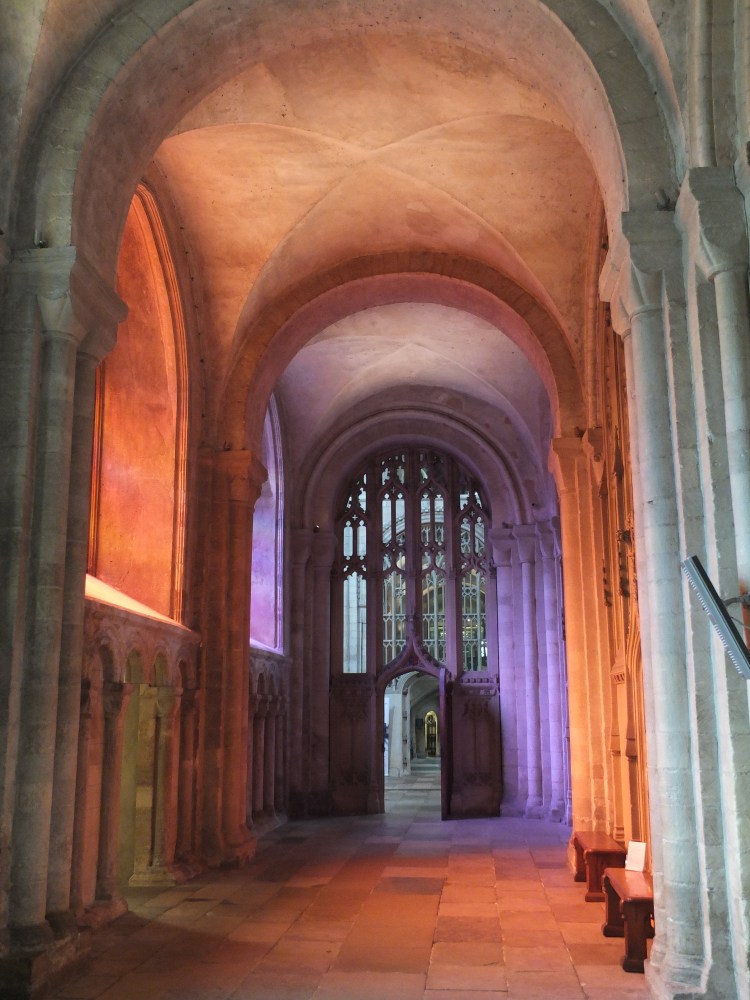
I walk slowly, calming myself in preparation for the upcoming worship. In front of me, the aisle is bathed in orange and purple. Here, the light is falling through the three windows, which are only using the three primary and secondary colours, symbolising the Holy Trinity. Moving through this pool of colours, I step into the north transept. I direct my steps to the entrance of the St. Andrew’s chapel on the east wall, spending some time in quietness, as this chapel is set aside for prayer and the holy sacrament.
A few minutes later, I am sitting in the choir stalls in the south transept, rising up when the choir and the clergy enter. The precentor opens the evensong with the words ‘O Lord, open thou our lips’. It is a form of prayer that was developed after the Reformation, but is strongly based on the Opus Dei of the Benedictine monks, who prayed here, as in Rievaulx Abbey, until 1538, when this monastery was also dissolved. Today, the people who come here every day are no longer monks, but the cathedral clergy, the members of the choir and other worshippers, including regulars and visitors from all over the world. But otherwise, not much has changed. Every day, the choir sings one or more psalms, the Magnificat, the Nunc Dimittis, some prayers and an anthem. The biggest difference today from a few hundred years ago might be the outstanding musical quality of the choir, singing just how I imagine a choir of angels might sound. The music penetrates my heart, thus becoming part of my fabric as well as of these walls. At the end of the service, one chapter of the Rule of St. Benedict is read and we remember the dead before and after the Reformation, thus emphasising the Benedictine tradition of this place of worship.
After the choir and the clergy have left, I listen to an organ recital for a few more minutes before I leave. I am looking at these walls around me, standing here in the centre of the city of Norwich for 900 years, listening to the prayers rising to heaven from their midst. When you look closely, you can see their rough edges and sometimes small graffiti telling many stories of the people who have lived and prayed here over many generations. Today, I was part of this hopefully unending process of soaking these walls in prayer, so that these walls can release their godly veil forever.
 Stephan Jockheck